
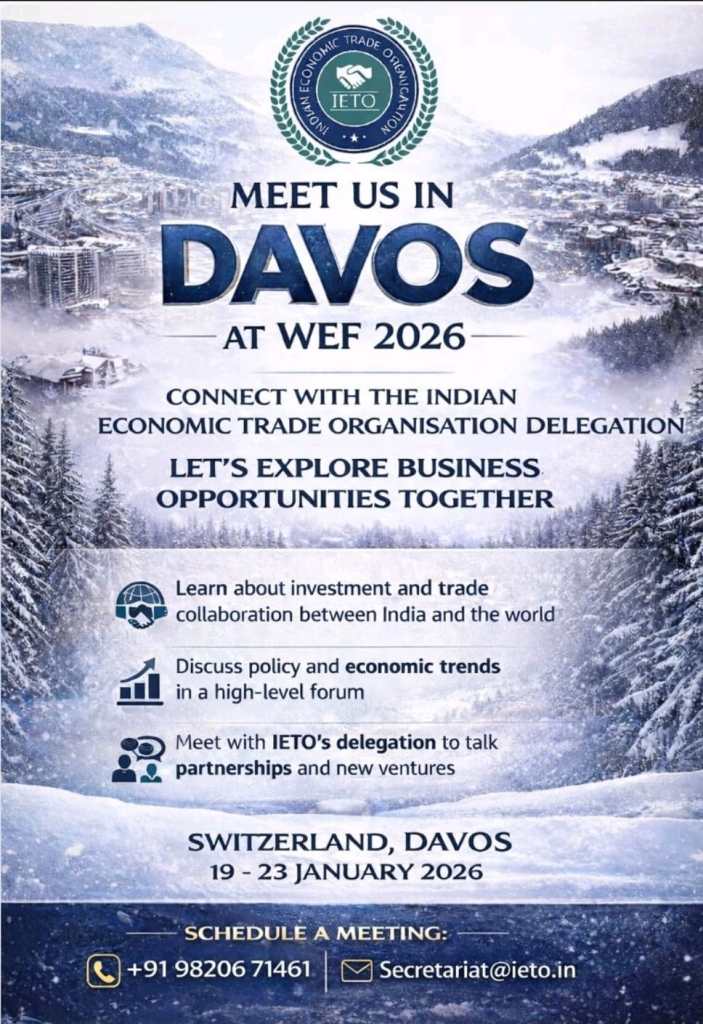

Davos, Switzerland, January 21, 2026 — On the sidelines of the World Economic Forum in Davos, a meeting between economic leadership and humanitarian vision reflected India’s expanding approach to global diplomacy. Dr. Asif Iqbal, President of the Indian Economic Trade Organization (IETO), and Mr. Wali Kashvi, Vice President of IETO, met with representatives of the Akshaya Patra Foundation to engage in discussions that highlighted how India’s development narrative increasingly blends trade, culture, and social impact on the international stage.
The interaction took place amid Akshaya Patra Foundation’s presence at the World Economic Forum, where the organization curated an experiential initiative serving nutritious Indian meals to international delegates. The effort formed part of a broader “Food for Education” narrative, presenting India’s civilizational values of service, sustainability, and community welfare through a contemporary global platform. Delegates from diverse regions experienced Indian cuisine not only as food, but as a cultural expression rooted in compassion and inclusivity.
Established in 2000, the Akshaya Patra Foundation has grown into the world’s largest non-governmental school meal programme, providing millions of hot, hygienic meals each day to children across thousands of schools in India. Its mission, centered on ensuring that no child is deprived of education due to hunger, aligns closely with global development priorities such as food security, education access, and social equity. Over the years, the Foundation’s work has demonstrated how structured nutrition programmes contribute to improved school attendance, learning outcomes, and long-term human capital development.
At Davos, the initiative was led by Naveena Neerada Dasa, Executive Director of Strategy and International Relations at ISKCON Bangalore and the Akshaya Patra Foundation. His engagement with global stakeholders reflected how India’s spiritual and cultural philosophies continue to inform modern development models. By presenting annadanam, the tradition of food as service, in a global economic forum, Akshaya Patra offered a powerful example of soft power rooted in action rather than rhetoric.
During their meeting with Naveena Neerada Dasa, IETO expressed deep appreciation for Akshaya Patra’s contribution to enhancing India’s global image. Discussions explored avenues of collaboration that would align humanitarian initiatives with economic and trade-driven outreach. Both sides acknowledged that food systems, agricultural supply chains, rural livelihoods, and education form an interconnected ecosystem, one that can be strengthened through international trade partnerships and cross-border cooperation.
Dr. Asif Iqbal, President, Indian Economic Trade Organization, stated, “
India’s global engagement must combine economic strength with social purpose. The Akshaya Patra Foundation’s work reflects how compassion-driven initiatives can complement IETO’s vision of inclusive trade, rural empowerment, and sustainable international partnerships.”
As India continues to position itself as a bridge between emerging economies and established markets, collaborations that connect trade institutions with social impact organizations signal a mature and multidimensional diplomatic strategy. The meeting at Davos between IETO and the Akshaya Patra Foundation stands as a reflection of this evolving narrative, where economic growth, cultural identity, and humanitarian responsibility move forward together on the global stage.


About The Author


